
What's the Difference Between Servicing & Inspecting Extinguishers?
Your monthly checklist says, "check fire extinguishers," so your shift lead walks the building, glances at the gauge on each unit, confirms the pin is still in place, and initials the tag.
Done. Compliant. Box checked.
Then, eleven months later, a fire marshal or your insurance adjuster asks for your extinguisher service records, and you hand over a stack of monthly inspection tags. They ask where the annual maintenance tag is, the one from a licensed technician who opened the unit. You don't have one. Suddenly you're staring at a citation, and worse, you're realizing that several of your extinguishers may not have worked even if a fire had broken out last week. Before you assume your monthly walk-through has you covered, here's what the difference between an inspection and a service actually means, and why conflating the two is one of the most common (and most expensive) mistakes a business can make.
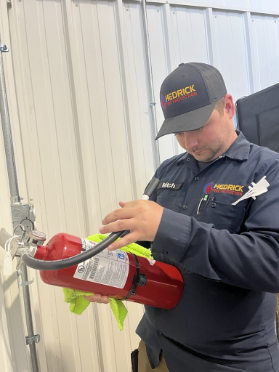
Annual Inspection - Hedrick Fire Protection Idaho
A technician in a Hedrick uniform performing an annual inspection on a fire extinguisher against a metal wall.
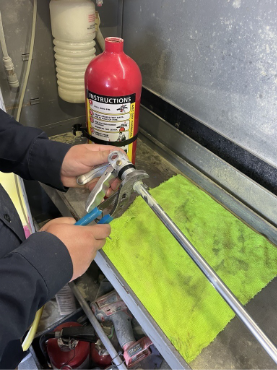
6 Year Service - Hedrick Fire Protection Idaho
Person using a wrench on a metal surface with a red fire extinguisher in the background performing a 6-year fire extinguisher service.
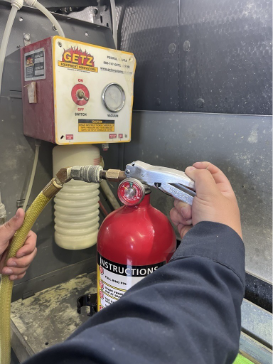
Recharge & Refill - Hedrick Fire Protection Idaho
Person holding a fire extinguisher with a GETZ pressure gauge in the background.
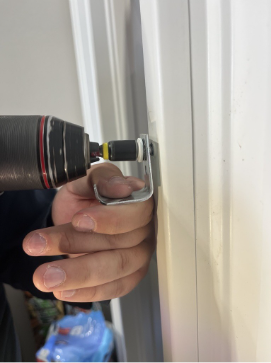
Extinguisher/Cabinet Mounting & Installation - Hedrick Fire Protection Idaho
Hand using a drill to install a wall mount for a fire extinguisher.
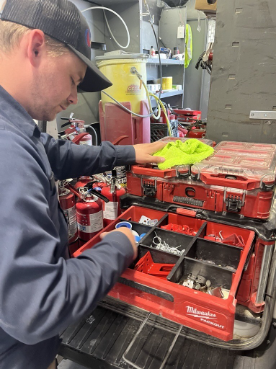
12 Year Hydrostatic Test - Hedrick Fire Protection Idaho
Person organizing tools in a Milwaukee tool chest in a workshop setting.
Email us: ar@hedrickfireprotection.com
Our services: https://hedrickfireidaho.com/services
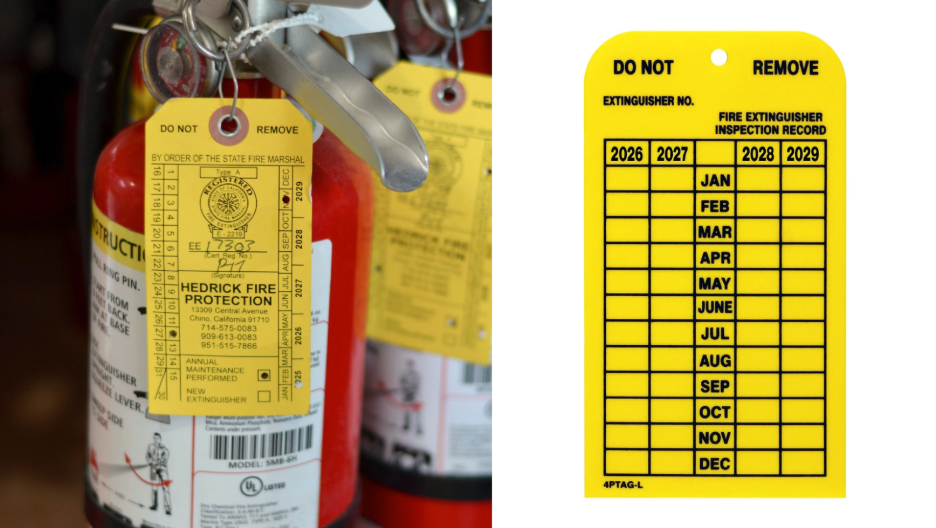
(Picture of a certified tag VS noncertified tag to see the difference)
What to Do Right Now
- Check Your Tags: Walk over to any extinguisher and look at the tag hanging from the handle. If you only see initials and dates with no technician signature or company stamp, you've likely only been completing inspections, not services.
- Check the Last Service Date: Fire extinguishers require professional maintenance annually, at minimum. If it's been longer than 12 months since a licensed technician serviced your units, you are out of compliance right now, not eventually. Schedule an annual inspection: https://hedrickfireidaho.com/services
- Don't Assume a Full Gauge Means a Working Extinguisher: A gauge needle sitting in the green tells you there's pressure in the tank. It tells you nothing about whether the powder inside has caked into a solid block or whether the internal seals have degraded.
- Call a Licensed Fire Protection Technician: If you're not certain when your last annual service happened, get a technician out to bring every unit current and get proper documentation on file before anyone asks for it. Call us: (208) 228-5985

Technician holding a clipboard and checking fire extinguishers
Two Different Jobs Wearing the Same Hat
Most business owners think of "checking the extinguisher" as a single task that just happens during a quick monthly look and a more thorough yearly look. That assumption is exactly backwards, and it's the root of nearly every extinguisher violation we see in the field.
Monthly Visual Inspections
Myth: A monthly inspection is just a smaller version of the annual service.
Reality: A monthly inspection is not a maintenance activity at all. It's a verification activity. You, your manager, or any trained staff member is simply confirming that the extinguisher is physically present, visible, unobstructed, and shows no obvious signs of damage (i.e., full gauge, intact pin and tamper seal, no dents or corrosion, and a legible label). Nobody opens the unit. Nobody touches the internal components. It takes about thirty seconds per extinguisher and requires no certification to perform.
The Bottom Line: A monthly inspection can tell you an extinguisher is sitting where it's supposed to be. It cannot tell you the extinguisher will actually function.
Give your team the knowledge to respond confidently. Our equipment demos and training help your staff understand what they have, how it works, and how to use it when it matters most. https://hedrickfireidaho.com/demos-training

Photo of a clock and a fire extinguisher
Annual Maintenance Service
Myth: If the extinguisher passed every monthly inspection all year, the annual service is just a formality.
Reality: An annual service is a hands-on mechanical and chemical evaluation that can only legally be performed by a licensed fire protection technician. The technician removes the extinguisher from the wall, examines the internal condition of the cylinder for corrosion, verifies the mechanical parts of the discharge valve actually function, and, most importantly, checks the agent inside. Dry chemical powder settles and cakes over time, especially in units that get jostled, exposed to humidity, or simply sit untouched for a year. A technician will invert and shake the unit to break up that caking, and depending on age and type, the extinguisher may need a full teardown, recharge, or hydrostatic pressure test of the cylinder itself.
The Bottom Line: The annual service is the only point in the year where anyone actually confirms the extinguisher can put out a fire. Everything else is a presence check.
The Six-Year and Twelve-Year Milestones
Myth: As long as you're getting annual service done, your extinguishers are fully compliant indefinitely.
Reality: Most rechargeable dry chemical extinguishers require a full teardown of the valve and internal components at the six-year mark, and a hydrostatic test of the cylinder itself at twelve years, regardless of how clean the annual services have looked. These deeper milestones exist because certain failure modes, like stress fractures in the cylinder wall, simply don't show up during a routine annual check.
The Bottom Line: "Serviced annually" and "fully compliant" are not automatically the same statement once a unit ages past six years.
LIABILITY WARNING: NFPA 10 governs portable fire extinguisher maintenance and explicitly distinguishes between monthly inspections and annual maintenance, with separate, mandatory standards for each. If your business experiences a fire and your only documentation is a stack of monthly inspection tags with no annual service record from a certified technician, your commercial insurance carrier has grounds to deny your claim outright, and the Authority Having Jurisdiction can cite you for noncompliance even if every extinguisher discharged successfully.
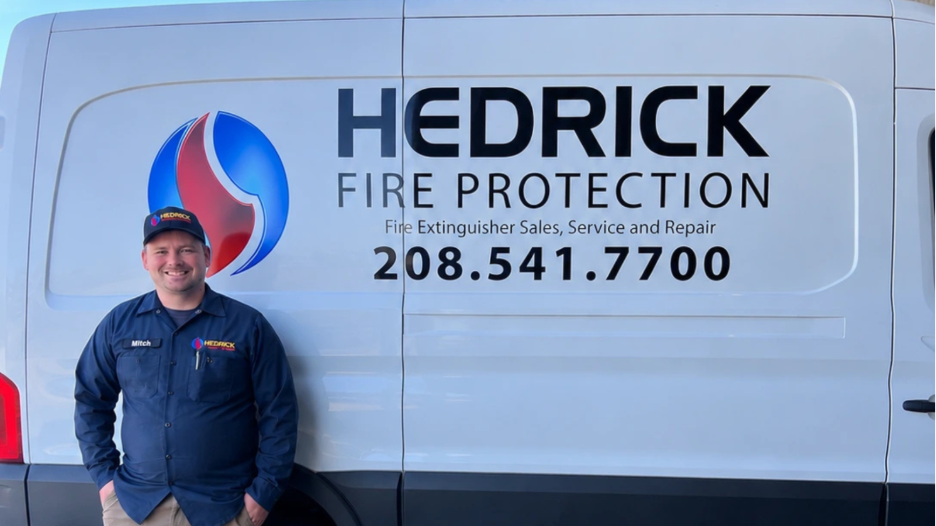
Technician standing in front of Hedrick Fire Protection Service truck.
Getting Both Halves Done Right
You don't need to choose between doing inspections yourself and bringing in a professional. You need both, on two completely different schedules, and you need to know which one you're actually capable of doing in-house.
When you bring in Hedrick Fire Protection for annual extinguisher service https://hedrickfireidaho.com/annual-inspection , our certified technicians don't just glance at a gauge. We pull every unit, invert and agitate the agent to prevent caking, inspect O-rings and seals for degradation, verify the discharge mechanism under controlled pressure, and track which units are approaching their six-year teardown or twelve-year hydrostatic test before they become a compliance surprise. We tag every unit with proper documentation that will hold up under an insurance audit or a fire marshal's request, not just initials on a paper tag.
Are you confident your fire extinguishers would actually work if you needed them tonight, or just confident they passed last month's glance? Click here to contact the Extinguisher Service Team https://hedrickfireidaho.com/services at Hedrick Fire Protection to schedule your annual maintenance today.